



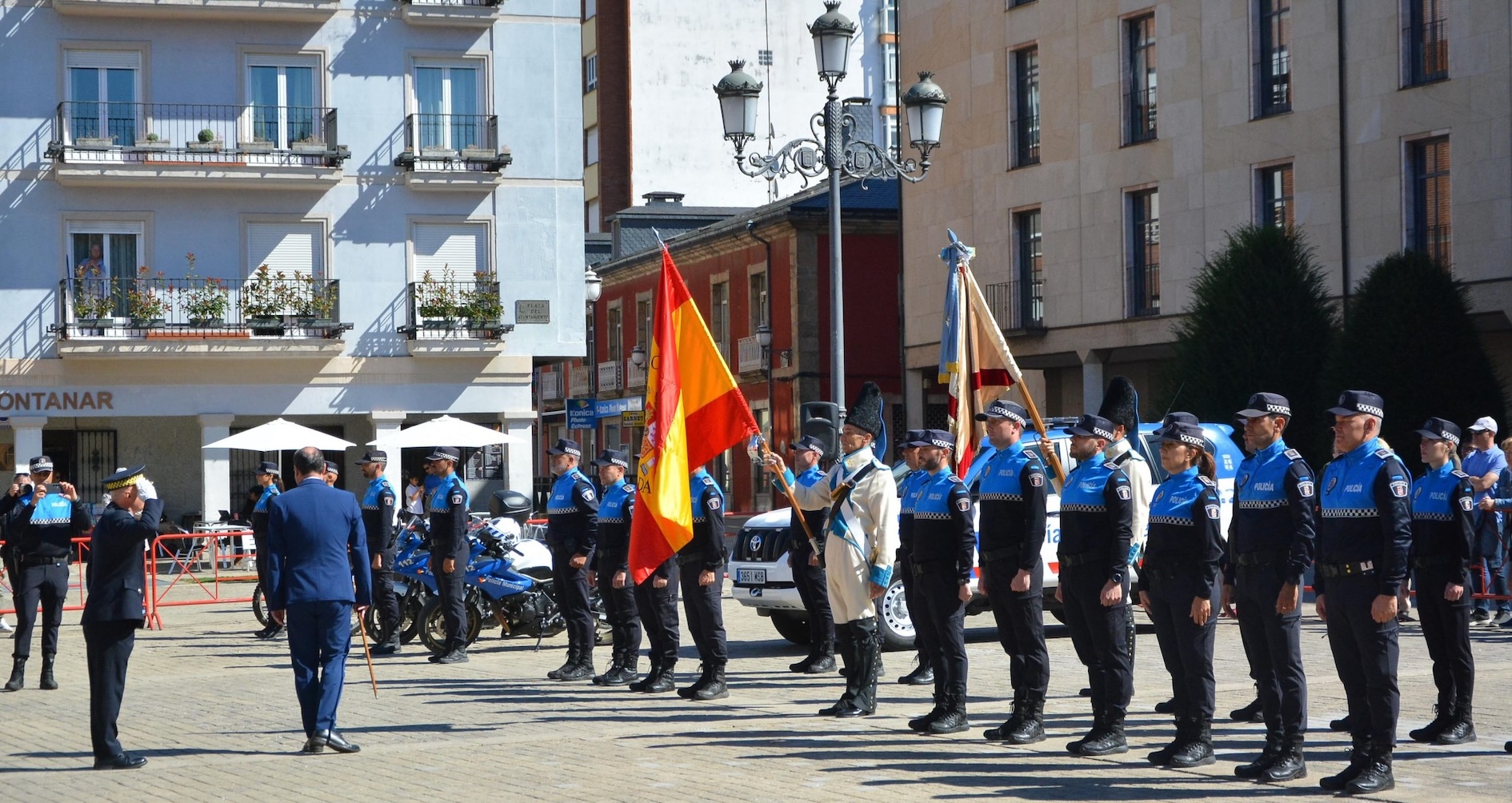
Ponferrada, Spain, September 2026 – “We are your police”. This is the slogan used by Ponferrada City Council (Spain) to define the role of its municipal police force. Launched in the late 1990s, this model – based on public participation and prevention – represented, at the time, a cultural revolution in a country still marked by the repressive nature of the police force inherited from the Franco era.
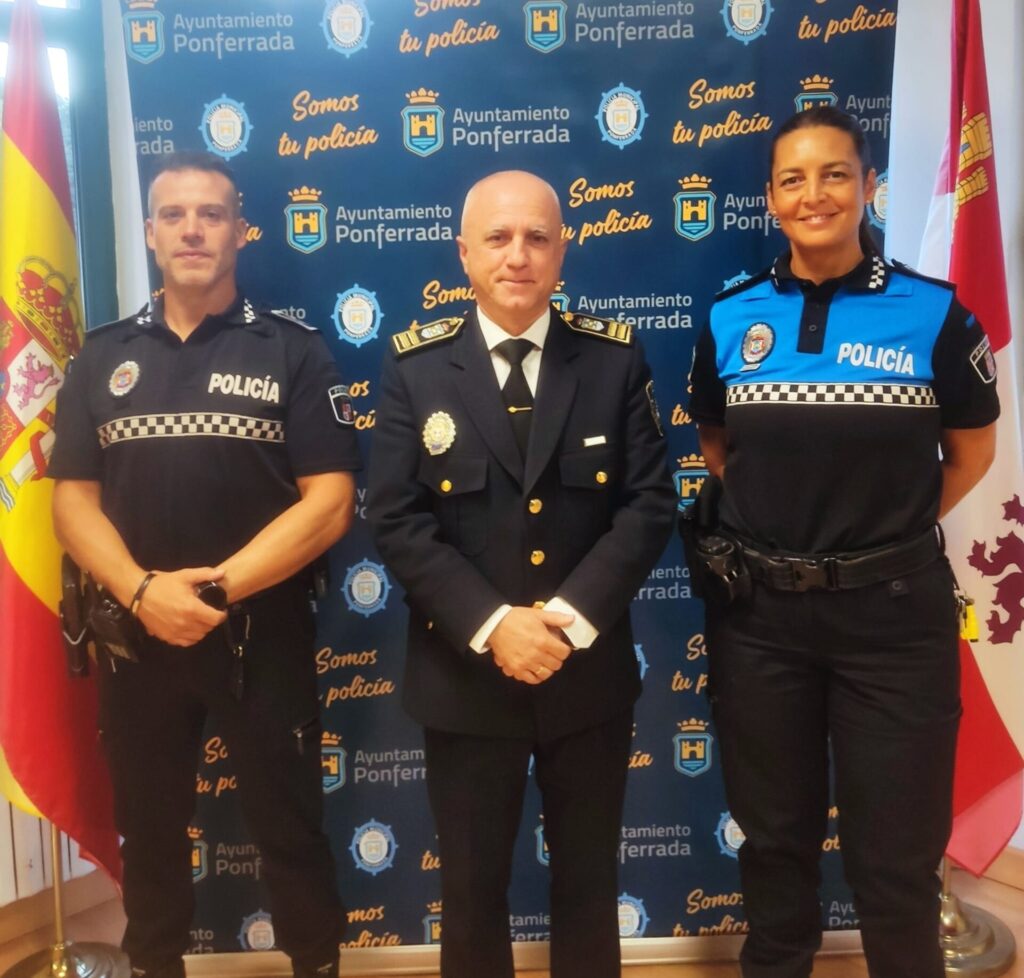
This model of policing at the service of citizens remains in force and up to date in this city of 64,000 situated in Castile and León, north-west of Madrid. We met with its chief since 1997, Arturo Pereira Cuadrado* (photo centre), accompanied by Vanesa López Barrio, a police officer (photo right), and Javier Fernández Santiago, a police officer (photo left).
Ponferrada has a reputation for being one of the safest cities in Spain. What are its main characteristics in terms of urban security?
Arturo Pereira Cuadrado (APC): Ponferrada is, indeed, a peaceful city where the crime rate is well below the national average. According to the most recent figures from the Ministry of the Interior, the crime rate stands at around 10.3 criminal offences per 1,000 inhabitants, while the national average in Spain is around 40.5 offences.
“We carry out preventive and social work with the local population, for example by supporting older people or preventing domestic violence, which is a significant issue here, as it is throughout Spain.”
In the city, we focus primarily on preventing social conflicts, particularly – though not exclusively – in the nightlife area, where we ensure the peace and quiet of local residents and compliance with noise regulations, in collaboration with the National Police. We carry out preventive and social work with the local population, for example by supporting older people or preventing domestic violence, which is a significant issue here, as it is throughout Spain.
We are also involved in traffic and road safety matters (traffic management, parking enforcement) and administrative and environmental control (inspection of planning permissions, noise levels, outdoor seating areas, street stalls and compliance with local by-laws).
One of the characteristics of Ponferrada is that 83 nationalities are represented within the population. Does this lead to conflicts between the different population groups?
APC: Yes, indeed, around 5 per cent of our population is of immigrant origin, which amounts to some 5,000 people. Many come from a wave of immigration dating back to the 1970s, which was linked to the industrial activity of the time. These are mainly people from Portugal and former Portuguese colonies. More recently, we have welcomed people from South-East Asia (Pakistan), as well as from Morocco and Colombia. This is a well-integrated community and there are no immigration-related conflicts or crime here, apart from around thirty individuals whom we know well and keep a close eye on.
What are the main aspects of the Ponferrada municipal police force?
APC: Our community policing model represents a shift in the organisational paradigm: it seeks to place people at the centre of policing and to move from reactive to proactive policing.
Under the institutional slogan ‘We are your police’, the Ponferrada model is structured around the following pillars:
- Neighbourhood committees
Rather than intervening only when a crime has been committed, the municipal police have set up neighbourhood committees in which police officers and representatives of residents’ associations meet regularly to assess the specific issues relating to community relations, safety or civic behaviour in each area before they escalate.
- Prevention and proactivity
Our model aims to identify and monitor local conflicts on a daily basis. Patrols do not merely keep watch; they become part of the neighbourhood’s daily routine to gather information directly from residents, with the aim of resolving the root causes of problems rather than merely applying ‘quick fixes’ to the symptoms.
- International partnerships and standards of trust
We are keen to forge links with colleagues in other countries to exchange best practice and experiences. To this end, we are members of the International Association of Chiefs of Police (IACP) and also of the European network EU-POLNET, part of the European Forum for Urban Security (Efus). We are taking part in the IACP’s Trust Building Campaign, which focuses on ensuring a transparent police force, free from prejudice and exercising force with the utmost restraint. This is reflected, among other things, in our police oath, in which all our officers pledge to serve the public with empathy and a sense of social connection.
- Adaptation to the rural-urban environment
Due to the municipality’s geographical spread (which includes numerous outlying neighbourhoods and districts), the community-based model decentralises efforts. This involves allocating specific resources to the local area, such as the ‘Green Patrol’ for mediation with farmers and livestock breeders, and a preventive presence on high-traffic routes such as the Camino de Santiago, as Ponferrada is an important stop on the route.
“We are confronted more frequently than in the past with situations involving people in crisis or suffering from mental health problems. Generally, we are called upon to intervene before medical staff arrive in order to bring the situation under control and prevent it from worsening.”
You are finalising a mobile app that will enable officers to identify mental health issues they may encounter and act accordingly. Have you noticed an increase in this type of problem?
APC: Yes, without a doubt. Nowadays, we are confronted more frequently than in the past with situations involving people in crisis or suffering from mental health problems. Generally, we are called upon to intervene before medical staff arrive, in order to bring the situation under control and prevent it from worsening. But this requires to correctly identify the nature of the problem and take into account the type of mental health crisis the person or people affected are going through, which demands specific medical knowledge.
That is why we have created an app that officers can download onto their mobile phones, enabling them to identify the type of mental distress involved and take the correct action to defuse a problematic situation before specialist medical teams arrive. It has been developed in collaboration with the Forensic Medicine Service and specialist lecturers in this field at the University of León. Everything is described in great detail, and officers can follow the process step by step as indicated in the app, without the risk of making mistakes.
More generally speaking, do you regularly use information technology?
APC: There is no doubt that new technologies enable us to mitigate what, in my opinion, is a staff shortage: there are 70 of us, and according to our legislation, there should be twice as many. We have therefore carried out a huge amount of work over the last ten years to go fully digital and eliminate paper: nowadays we work as a network, with all information shared in real time.
Furthermore, the city has a CCTV network, which in Spain is very strictly regulated by law in accordance with ethical principles and respect for privacy. We also use AI to streamline and speed up the reporting process for officers on the beat.
In conclusion, what would be your message to the member cities of the European Forum on Urban Security, as well as to the other local police forces that are members of the EU-POLNET network?
APC: It is very important for us to stay in touch with colleagues from all over the world. This enables us to broaden our knowledge, share our practices and keep up to date with developments in operational models and technologies. Every year we attend the International Association of Chiefs of Police conference; the next one will take place in October in Orlando (Florida, USA). We are delighted to have joined the EU-POLNET network, which provides us with a more specifically European perspective.
* Arturo Pereira Cuadrado, who holds a PhD in Law and a diploma in Criminology, is a Member of the Royal Academy of Spanish Jurisprudence and Legislation, a Lecturer and Tutor in Law at the National University of Distance Education, and a contributor to university chairs
> More information on the European network of local police forces, EU-POLNET
> More information on Efus’ work on the issue of police
>The Ponferrada City Council website