





February 2026 – “Humanity is about to be handed almost unimaginable power, and it is deeply unclear whether our social, political, and technological systems possess the maturity to wield it.” This is the warning one of the world’s leading specialists on generative AI, Dario Amodei, recently gave*.
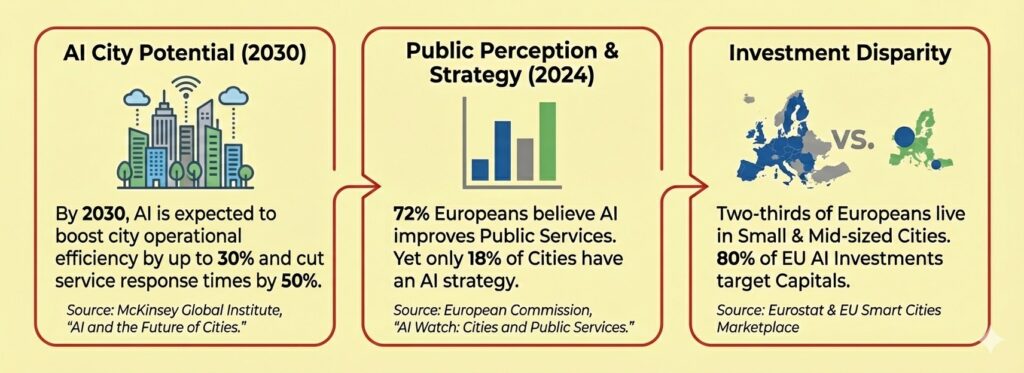
Cities across Europe, where about 75% of the EU’s population live, are grappling with this exponentially-evolving technology, which is perceived with as much anxiety as hope. What is certain is that it will revolutionise just about every aspect of city administration, including urban safety.
Urban security and AI
Indeed, local security is a domain where generative AI is already quite widespread: it is embedded in CCTV networks and command centres, which are ubiquitous in European cities (although much less than in the USA) and are increasingly equipped with AI technology to analyse the data collected and produce dashboards; it is behind the chatbots that guide citizens through a whole range of administrative services (education, transport, social care and so on) and are increasingly intelligent; it is in the command centres where urban traffic flows are managed in real time. The list could go on…
Looking for guidance
The European Forum for Urban Security (Efus) is conducting a project titled AI for Cities** whereby city officials from across Europe can receive free training in AI fundamentals. In each country, the training is given in the native language and adapted to the local context.
The feedback we’ve got so far from participating cities shows a mixed bag of responses among city administrations to the coming generative AI wave. “Some Efus member cities have embraced AI and are implementing it in a responsible, ethical way, in line with the European Union’s recommendations. This is particularly the case for some large cities, which have dedicated staff and/or departments. Other generally smaller cities do not have the personnel or budget for a dedicated department and some of their staff are more suspicious: they fear the impact AI will have on jobs, but also on the environment,” notes Asma Kaouech, Senior Programme Manager.
The rights of European citizens are at the heart of the European law on AI, which provides a solid protective shield against invasion of privacy and manipulation.
European law
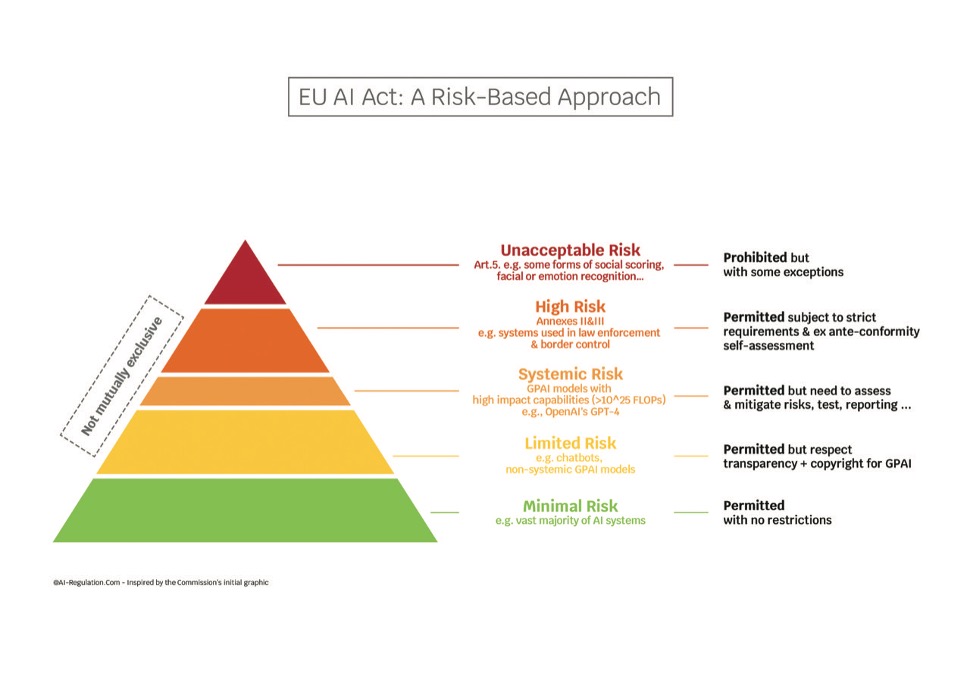
Apart from national legislation, cities can find guidance and a wealth of practical recommendations in the EU AI Act, which came into force in August 2024. Its core requirements must be fully enforced in August this year and the remaining provisions in 2027.
The European Union is the first major jurisdiction to adopt a comprehensive, legally binding AI law, which sets global standards using a risk-based approach, banning high-risk AI, regulating high-risk systems, and addressing transparency.
If we were to sum up this hefty document, let’s say that it places the fundamental rights of citizens at its heart. The Act gives European citizens a solid protective shield against invasion of privacy and manipulation compared to citizens of other regions of the world. In this sense, the EU is a frontrunner and has set a benchmark (which explains why US-based big tech companies are so keen to counter any type of EU regulation, but that’s another story).
Human in the loop
Back to the local, municipal level, the key insight from the AI for Cities training programme is what specialists call “human in the loop” (HITL), which means that humans guide AI systems to improve accuracy and reliability. This model is used by specialists when ‘teaching’ AI systems, but it can also be used as a core principle by city administrations when rolling out the technology, especially in urban security projects that may have direct or indirect consequences on individual freedom or rights.
For example, if generative AI is used to alert city officials when a large crowd gathers unexpectedly in a public space, what guarantees did we put in place to protect individuals’ right to privacy? Can we make sure there won’t be any racist or sexist bias embedded in our systems that would, for example, point out certain groups of population as “suspicious” in a given situation?
The principle of ethical, transparent and citizen-centred AI is the key; it is the one principle that we can apply in all our AI projects related to urban security, or indeed any other local policy domain.
Some European cities have already adopted an AI strategy based on ethical, transparent and rights-based use of the technology. They can inspire other European local and regional authorities.
Three city case studies: Amsterdam, Barcelona, Strasbourg
Without pretending to present a comprehensive study of how Efus member cities are approaching generative AI, we thought it interesting to mention three of them because they have adopted an ethical, human-centred approach. These are Amsterdam (Netherlands), Barcelona (Spain), and Strasbourg (France).
> A leading European AI hub, Amsterdam has developed the Amsterdam Vision on AI as part of its overall AI strategy, which focuses on implementing a human-centred, ethical approach to AI that prioritises public value and digital sovereignty (i.e., keeping control of the use of the technology). The City Council seeks to use AI in priority to improve urban life for citizens, notably in sustainable energy, urban mobility and digital government services.
> Barcelona has also forged a thriving high-tech, AI sector and is developing a municipal AI strategy that centres on “digital humanism” and ethical, transparent and rights-based use of AI in all public services. The strategy is based on seven governing principles that have to be followed in any technological application to ensure correct risk management, respect for digital rights and public responsibility: human action and supervision; technical robustness and security; data privacy and governance; transparency; diversity, inclusion and fairness; social and environmental commitment; and responsibility, accountability and democratic control.
> The city and Eurometropolis of Strasbourg has adopted an AI strategy based on three principles: sobriety, solidarity, and freedom. As such, local authorities that are part of the Eurometropolis commit to using AI “in a proportionate and resource-efficient manner.” They also commit to “equal access to public services, the prevention of algorithmic bias and respect for the right to digital integrity.” As for the third principle, “Strasbourg promotes technological sovereignty and data security. The use of open source, European and locally hosted solutions is preferred. The use of AI will be completely transparent, with human intervention mandatory in all important decision-making.” The city has adopted a Charter for the ethical use of artificial intelligence that can inspire other local and regional authorities.
Guiding light
As Efus progresses in the roll-out of the AI for Cities programme – we’ve recently completed sessions for German cities and will start training Belgian, Dutch and Italian ones over the next few months –, we learn more about local authorities’ expectations, needs and concerns regarding the use of generative AI in urban security.
It is obvious that we’re on the cusp of a sweeping technological revolution that will probably impact every aspect of our lives, but if we keep as a guiding light this human-first principle in all our AI initiatives and projects, there may be no reason to feel daunted.
More
> If you want to share your experience, practices and ideas on this subject, feel free to join us on our Safer Together LinkedIn group
> More on the AI for Cities programme
> More on Efus’ work on technologies and urban security
> Our Manifesto’s recommendations on the topic of technologies
* The Adolescence of Technology
** Funded by the Centre for Public Impact (CPI) with support from the Google.org AI Opportunity Fund, this Efus-led project seeks to train 175 officials and elected representatives of European cities from six countries: Belgium, France, Germany, Italy, the Netherlands, and Spain.
*** This article was human generated
Photo ©iStock – Alvarez
Source for the chart at the top of the article: https://mayorsofeurope.eu/ai-cites/


