



June 2026 – Determined to find through collective action ways to strengthen prevention and the response to drug-related violence, mayors, elected representatives and officials from European cities and regions have signed a pledge to join the Coalition of the willing – against drug-related violence and trafficking.
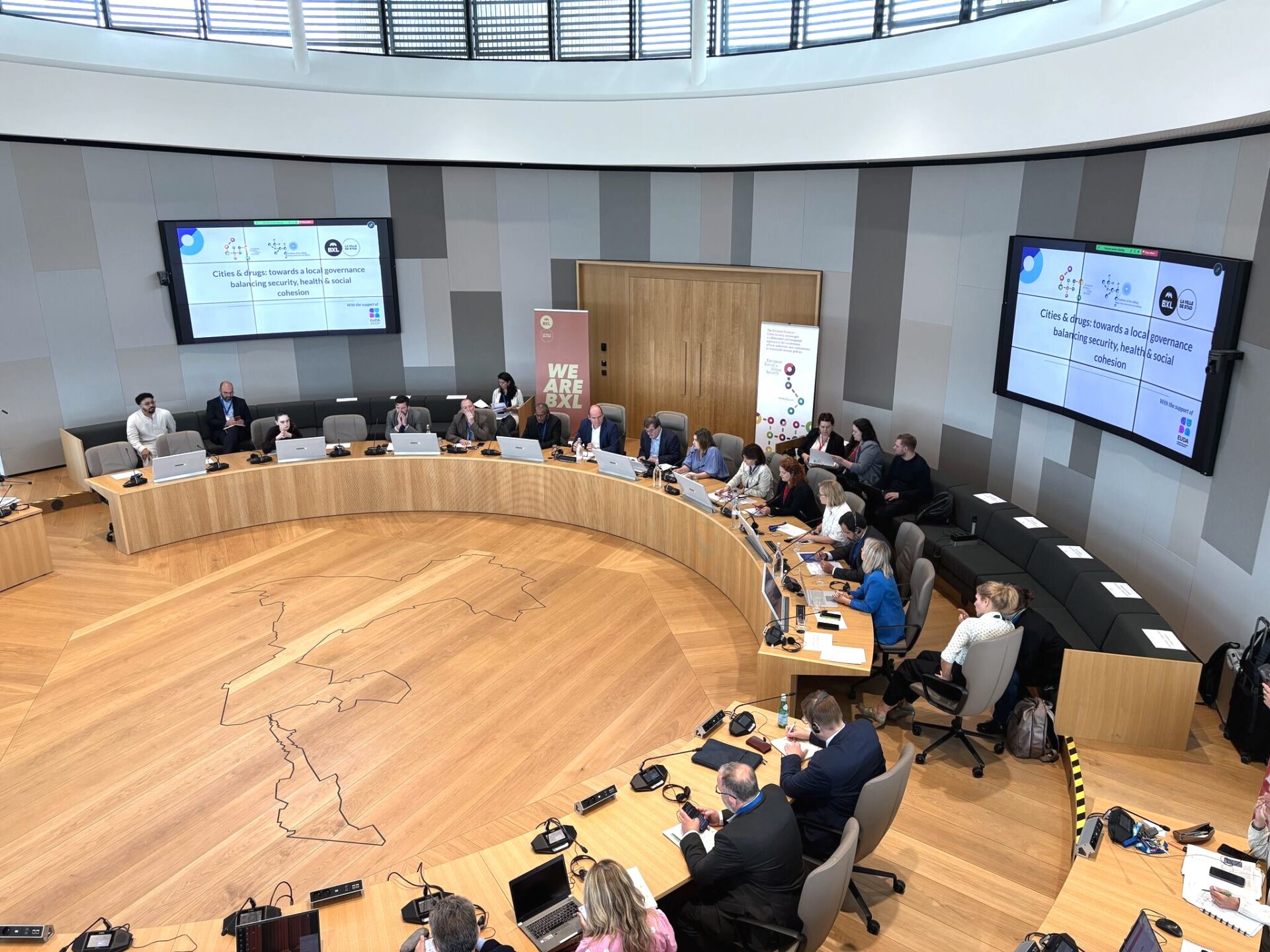
They did so during the Cities and Drugs conference organised by Efus jointly with the city of Brussels and with support from the European Union Drugs Agency (EUDA), on 17 June in Brussels (photo).
Many European local authorities are already developing comprehensive, innovative and effective local strategies for prevention and control. The Coalition of the willing is a proactive and pragmatic coalition of European cities and regions whose aims are to strengthen, share and promote these promising initiatives.
> Below are the key takeaways of the Cities and Drugs conference
> The full report and the replay are available for our members here
Tackling the root causes of organised crime, not just its visible manifestations
The fight against organised crime cannot be limited to visible acts of violence, drug seizures or arrests. The criminal activities observed in public spaces are merely the tip of a much larger iceberg. Public policy must also tackle the fertile ground that fosters the development of criminal networks: social inequalities, school drop-out rates, poverty, the fragility of public services, discrimination and a lack of prospects for young people. Addressing these structural factors is essential to sustainably reducing the influence and infiltration of organised crime.
Changing narratives and strengthening social cohesion to prevent the expansion of criminal networks
Organised crime does not merely generate violence; it gradually transforms the social perceptions and aspirations of a section of young people. Criminal organisations exploit economic, social and identity-related vulnerabilities to offer alternative models of success based on easy money, power and social recognition. Prevention policies must therefore go beyond mere awareness-raising and help to rebuild positive narratives, promoting civic engagement, education and pathways to integration in order to restore social cohesion.
Social media and digital platforms are used for recruitment, the promotion of criminal lifestyles, the dissemination of violent content, certain forms of money laundering, and for coordinating trafficking.
Recognising overseas territories as testing grounds for anticipating criminal trends
Overseas territories serve as prime observatories for trends in organised crime. The trends that emerge there at an early stage often foreshadow those that will subsequently affect mainland territories. They also reveal how economic vulnerabilities, shortcomings in public services and regional inequalities can be exploited by criminal networks. The lessons learnt from these territories must inform national and European prevention and security strategies to a greater extent.
Embracing the digital sphere, which has become a key arena for criminal networks
Counter-crime strategies remain largely focused on physical spaces, even though an increasing proportion of criminal activity is now organised online. Social media and digital platforms are used for recruitment, the promotion of criminal lifestyles, the dissemination of violent content, certain forms of money laundering, and for coordinating trafficking. It has become essential to develop intervention, prevention and investigative capabilities tailored to these new digital spaces by drawing on specific expertise and partnerships with digital sector stakeholders.
Strengthening the capacity of local authorities to take action, in particular through administrative and financial tools
Local authorities possess in-depth knowledge of their local areas, which must be utilised more effectively in the fight against organised crime. Several European examples (Belgium, the Netherlands) show that administrative tools enable swift action to be taken against businesses suspected of being involved in money laundering or criminal activities, without having to wait for the outcome of lengthy legal proceedings. This approach forms part of a broader strategy aimed at striking at the economic resources of criminal organisations, in accordance with the now widely recognised principle of tracking and drying up illicit financial flows.
Prevention is not merely about raising awareness of the risks; it involves taking early action to address the factors of vulnerability that facilitate the grip of criminal networks.
Making prevention a cornerstone of drug policy by fully integrating public health
Whilst legislative and regulatory frameworks designed to strengthen penalties and law enforcement are being developed in many European countries, prevention remains the poor relation of public policy. Yet prevention is not merely about raising awareness of the risks; it involves taking early action to address the factors of vulnerability that facilitate the grip of criminal networks.
This approach requires broadening security policies to fully incorporate public health, mental health and addiction issues. It entails breaking down silos in public policy and involving health professionals, social workers and frontline staff more closely in security strategies, in order to sustainably strengthen the resilience of local communities.
Building resilient societies through an integrated approach combining prevention, law enforcement and cooperation
Criminal networks are characterised by their adaptability, mobility and economic power. In the face of these developments, it is essential to move beyond the dichotomy between prevention and law enforcement. Both approaches must be developed simultaneously, with appropriate resources, expertise and legal frameworks. The resilience of local communities also depends on enhanced cooperation between local authorities, national governments, European institutions, researchers, civil society and practitioners on the ground. It is this integrated approach that will enable us to develop sustainable responses to an ever-changing organised crime landscape.
Strengthening cooperation between local authorities to tackle drug-related challenges
Faced with a complex and constantly evolving phenomenon, no city or local authority can claim to hold the solution on its own. Mayors and local elected representatives who demonstrate consistent political courage must not remain isolated, but must join forces to develop collective responses. The aim is not to seek a single solution, but to encourage experimentation, the sharing of experiences and the promotion of initiatives already implemented at the local level. By strengthening cooperation between local authorities, it becomes possible to accelerate innovation, disseminate practices that work and build a more coherent and resilient European response to drug-related challenges.
> More on Efus’ work on the issue of drugs
> The full report on the conference and the replay are available for our members here